Physical AI · OS for Shared Spaces / Operational Spaces
Operating Intelligence Together
One physical world. Many operational realities.
Robots, fleets, operators, public authorities and human teams each work from their own models, objectives, procedures and decision rights. The CompoundWorks vision starts with that plurality. The architectural question begins when a decision made in one operating reality changes what others can do.
Illustrative operating spaces. Coordination depends on the particular boundaries and dependencies of each operation.
The coordination threshold
When is a shared layer justified?
Start with the dependency. What does one participant need to know, agree to or verify about another participant’s action? Can the mechanisms already in place handle it?
Local autonomy
A single system can handle the task within its own operating envelope, using local perception, planning, control and safety.
Conventional orchestration
A fleet manager, traffic system or command-and-control (C2) system can coordinate dependencies within the scope it can see and legitimately manage.
Direct peer coordination
Participants can exchange what they need for a limited interaction, such as two vehicles negotiating passage at a junction.
Shared operating capabilities
When consequential dependencies cross independent operating or authority boundaries, participants may need a bounded way to share context, establish who can act and track commitments.
Ten robots under one effective fleet manager may need no additional layer. Two independently operated vehicles may need shared capabilities if a restriction, right of way or commitment affects both and existing mechanisms cannot handle it. Established infrastructure can provide those capabilities.
Deployment complexity
Three dimensions shape the operation.
The dimensions interact. A stale report matters more when several teams depend on it and different organisations can change the operating constraints.
Environmental Uncertainty
Relevant physical conditions may be incompletely observed, changing, disputed or described by stale data. Look for sensor gaps, contradictory reports or rapidly changing hazards. These affect which claims participants can rely on, and for how long.
Operational Coupling
One actor’s plan or action constrains or depends on another’s. Look for shared workspaces, scarce resources, handovers and timing commitments. A local change can cascade across the operation, including while communications are down.
Authority Dispersion
Decision rights and accountability sit with different actors, operators or institutions. Look for overlapping jurisdictions, scoped permissions and temporary delegation. Participants need to establish whose decision applies, where and until when.
Illustrative scenario profiles
Factory
City
Battlefield
The City band on operational coupling shows episodic, incident-driven variation. Marker shapes and vertical offsets distinguish the scenarios; only horizontal position relates to the scale.
Environmental uncertainty
ENGINEERED / BOUNDEDDYNAMIC / CONTESTED
Illustrative positions: Factory is nearer the engineered and bounded end. City is towards the dynamic end. Battlefield is beyond City towards higher environmental uncertainty.
Factory
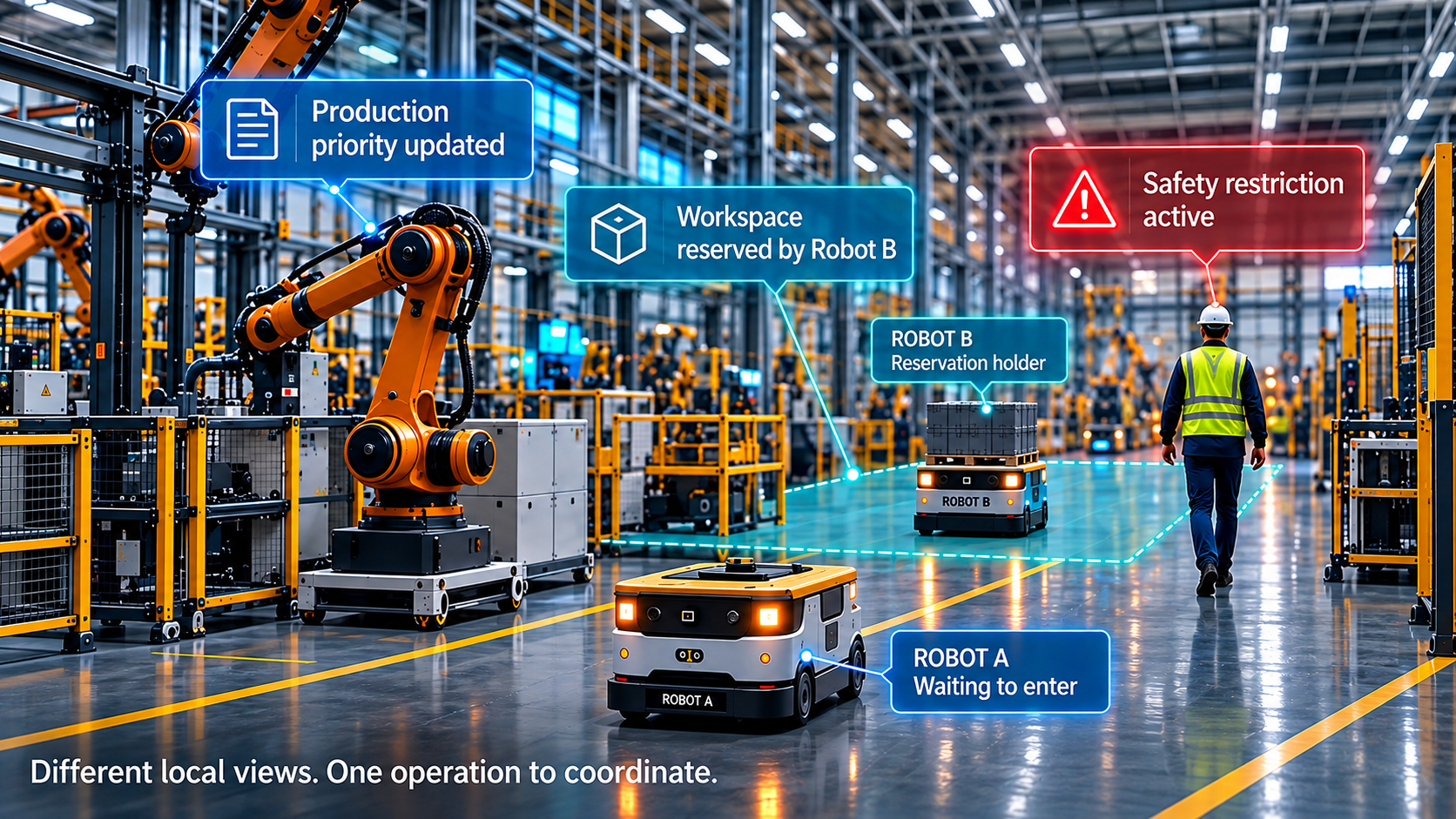
Engineered floor with changing occupancy and restrictions.
City
Dynamic, open and partially observable.
Battlefield
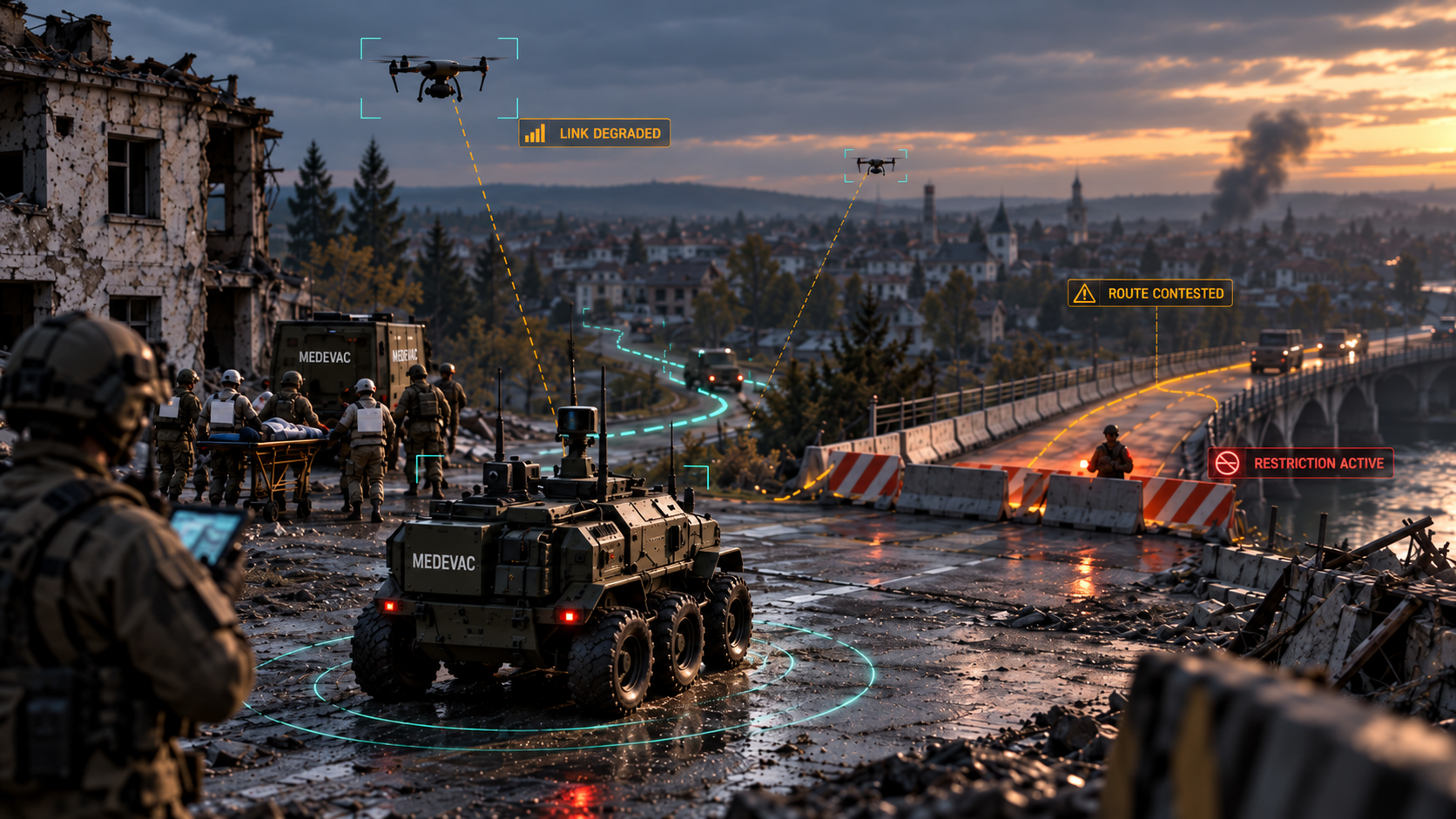
Dynamic, partially observable and deliberately contested.
Operational coupling
ISOLATEDHIGH
Illustrative positions: Factory and this Battlefield medical evacuation have comparable strong coupling. City spans lower coupling through strong incident-driven dependencies.
Factory
Strong dependencies around shared workspaces, production priorities and technician access.
City
Variable coupling that can become strong during emergencies.
Battlefield
Strong mission dependencies in the illustrative medical evacuation, even during communications loss.
Authority dispersion
CENTRALISEDDISTRIBUTED
Illustrative positions: Battlefield lies between the Factory and City authority-dispersion references, rather than at the maximum.
Factory
Production, safety and maintenance hold distinct rights within an organisation.
City
Independent operators, infrastructure owners and public services.
Battlefield
Formal command, delegation and coalition responsibilities. Loss of contact can make existing authority harder to exercise or verify.
Illustrative qualitative profiles based on the scenarios explored in this series. They are not measured complexity scores or universal rankings of factories, cities and battlefields.
Adversariality can stress all three dimensions. Deception undermines observations, disruption strains dependencies, and spoofed instructions make authority harder to verify. The combination of conditions determines which observations, authority and commitments participants need to coordinate. The six requirements below describe what that coordination must support.
Operating requirements
What must the operation support?
Consider these six requirements together. A contested restriction on a shared route affects what participants know, which decisions apply and what they can still commit to.
Preserve local autonomy.
Keep perception, motion planning, real-time control and safety with the systems and people responsible for them.
Establish shared operational context.
Give participants a common reference for the place, time, constraints and claims relevant to the operation, with uncertainty visible.
Make authority explicit, scoped and dynamic.
Record who can issue or withdraw a decision, the conditions under which it applies, and when that scope changes or expires.
Coordinate competing intentions.
Make conflicts over space, resources or timing visible and track which proposals become commitments, change or require escalation.
Federate across system boundaries.
Let independently governed participants exchange the necessary context and commitments under agreed roles and conditions.
Accumulate operational evidence.
Retain what participants knew, decided, reported and observed, with enough provenance to audit or learn from the operation.
Independent operators can agree on what they see and still disagree on what can happen next. A route can be physically open and outside an operator’s permission. A commitment that was feasible when accepted can become impossible when conditions change.
The six operating requirements connect what participants understand, what they can legitimately agree to and what they can carry out. Each participant retains the controls and accountability needed to act within its own operating limits.
Cognitive Alignment
Makes observations, forecasts and restrictions usable across different local views. It preserves their source, timing, validity and uncertainty. Updated context lets participants reassess whether a direction applies and whether a commitment is still feasible.
Operational Federation
Lets independently governed participants exchange the relevant context and coordinate within legitimate roles. It applies agreed participation rules and routes information and requests to the people and systems entitled to act on them.
Action Coherence
Relates proposals and commitments to constraints, local execution and outcomes. Participants can flag exceptions, revise commitments and reconcile what was reported with what was observed.
A disputed route restriction can change the context participants can rely on, which direction is legitimate and whether a truck can honour an existing commitment. Uncertainty, coupling and dispersed authority therefore affect several requirements at once. The three capabilities work together to maintain context, apply authority and coordinate intentions while preserving local autonomy.
How independent operators coordinate
Participants retain local control and accountability
Terminal ControlRuns terminal operations and maintains its local operating picture.
Trucking CompanyAssesses route feasibility and remains responsible for the truck’s movement.
Other port actorsPort Authority, Shipping Line, Customs and Emergency Services each retain their own responsibilities.
↕ Participants exchange scoped observations, constraints and commitments. Execution reports, observations and exceptions feed back into the operation.
Shared for the purpose and duration of the operation
Cognitive AlignmentShared context with inspectable claims and forecasts.
Operational FederationEligible participants, applicable authority and bounded exchange.
Action CoherenceIntentions, commitments, local actions and outcomes.
Context ↔ informs and is updated by applicable authority
Authority and scope ↔ shape and are reviewed against commitments
Commitments and outcomes ↔ depend on and update shared context
Feedback across all three. New observations can change which restriction applies. That can require revising a commitment. The response updates what participants know and may bring another responsible actor into scope.
Services support those exchanges throughout the operation
Operational TwinGrounds context and preserves claim provenance.
Human ParticipationLets accountable people interpret, decide and intervene.
Governance & AuthorityDefines legitimate roles, scope and constraints.
Operational EvidenceRecords decisions, execution reports and observed effects.
The figure shows functional responsibilities and feedback. Participants can distribute those responsibilities across their existing systems and exchange only what the operation needs.
Illustrative port terminal
How the architecture works in an operation
Follow the truck and the people coordinating its movement. The seven stages use the same events as Vision’s port scene and show what each participant needs to share and what each keeps under its own control.
Port overview. Participant markers show where the six local views originate.
Forecast route
Actual movement
Diversion
TC Terminal Control
C Customs
SL Shipping Line
T Trucking Company
PA Port Authority
ES Emergency Services
01 · Observe
Terminal Control, Customs, Shipping Line, Trucking Company, Port Authority and Emergency Services see different parts of the same operation through their own systems.
Capabilities
Cognitive Alignment identifies who saw what, when and where accounts differ.
Supporting services
The Operational Twin starts assembling the relevant context. Human Participation lets operators contribute or qualify what they see.
Local responsibility
Each participant owns its observations, procedures and decisions.
02 · Ground
The Terminal Operational Twin gives participants a common place and time reference for this movement. It brings together just the claims needed for the operation.
Capabilities
Cognitive Alignment makes the claims comparable. Operational Federation applies agreed limits on access and exchange.
Supporting services
The Operational Twin exposes the source, freshness and validity of each claim. Governance & Authority defines who can share and use it.
Local responsibility
Source systems retain their records and control. Their owners remain accountable for the information they contribute.
03 · Forecast
The proposed route would bring the truck to Gate A at 14:42. Participants can see the prediction alongside what they have already observed.
Capabilities
Cognitive Alignment keeps forecast and observation distinct. Action Coherence treats the route as a proposal until the responsible parties agree to a commitment.
Supporting services
The Operational Twin relates the proposal to the map and time reference and keeps its status visible.
Local responsibility
The Trucking Company can assess the route against its own operating constraints and procedures.
04 · Coordinate
Relevant participants open a temporary session to align intentions, constraints and resources for the movement. They can request a change and see which dependencies still need a response.
Capabilities
Cognitive Alignment gives the request shared context. Operational Federation routes it within agreed roles. Action Coherence distinguishes acknowledgement of receipt from acceptance of a commitment.
Supporting services
The Operational Twin grounds the exchange. Governance & Authority defines who can decide, Human Participation enables accountable intervention, and Operational Evidence can record each decision and its status.
Local responsibility
Participants remain responsible for their own decisions and for the commitments they accept.
05 · Execute
The truck begins moving. The scene shows the movement alongside the earlier forecast, making it possible to see where the two differ.
Capabilities
Cognitive Alignment keeps the sources of movement reports visible. Action Coherence compares the intended action with reported or observed execution.
Supporting services
The Operational Twin places movement in context. Operational Evidence can retain an operator’s execution report and a corroborating observation as separate records.
Local responsibility
The Trucking Company remains responsible for vehicle control and safe movement.
06 · Adapt
A new safety constraint blocks the original path. The truck diverts to a holding point.
Capabilities
Cognitive Alignment makes the current constraint visible. Operational Federation delivers the update within scope. Action Coherence tracks the response and whether the revised movement can be carried out.
Supporting services
Governance & Authority provides the applicable issuing role, scope and validity rules. The Operational Twin grounds the restriction. Human Participation supports intervention and Operational Evidence can retain the response and outcome.
Local responsibility
The truck operator applies local safety procedures and remains responsible for the diversion.
Illustrative alternative · The operator fails to acknowledge
Suppose contact drops after the restriction is sent. Once the expected response window closes, the session records a timeout and marks the revised movement as unresolved. It alerts the responsible coordinator. The operator follows established local fallback rules within its authorised limits. When contact returns, the participants reconcile the restriction, what each side knew and any reported or observed movement before treating the diversion as complete.
07 · Evidence
The temporary coordination session ends. The forecast, actual path, restriction and diversion outcome remain available for review.
Capabilities
Cognitive Alignment preserves what each claim meant at the time. Operational Federation ends the temporary participation scope. Action Coherence carries forward any unresolved differences.
Supporting services
Operational Evidence preserves the sequence and its sources. The Operational Twin supplies the context for interpreting it. Governance & Authority sets retention and access scope.
Local responsibility
Participants keep their systems, records and accountability after the session closes.
The same capabilities carry across settings. Their implementation depends on the local systems, the participants’ responsibilities and the scope of the operation. Explore the supporting services ↓
Supporting services
Where the shared responsibilities live.
Each service can support alignment, federation and action. These responsibilities may be implemented across fleet platforms, traffic and C2 systems, operator tools and distributed services.
Composes the operation’s shared referent from locally owned sources. It preserves provenance, temporal validity, freshness, uncertainty and disagreement so participants can interpret the situation and revisit decisions as context changes.
Human Participation
Gives people the role-specific views and controls to contribute observations, make accountable decisions and intervene or escalate. Use established operator stations, mobile tools or XR where the task calls for it. Explore Spatial Infrastructure.
Governance & Authority
Expresses legitimate roles, decision rights, applicable constraints, delegation and expiry. It lets participants check what authority applies before making or acting on a commitment.
Operational Evidence
Records what was available and when, which decisions and commitments followed, what was reported as executed and which effects were independently verified. It supports review, learning and reconciliation.
Share the minimum context and coordination needed for the operation. Each participant retains its local perception, autonomy, control, safety systems and accountability. Participation and any delegation are bounded by the purpose, conditions and decision rights that apply.
Operational Spaces
Three applications of the architecture.
Cognitive Factory
Coordinate shared workspace reservations across production, safety and maintenance, alongside MES, WMS and fleet management.
What must be shared for intelligent systems to operate together—and what should remain local?
Define the minimum shared operating reality and the coordination it needs. The Vision explains why operating realities remain locally owned. The Scaling System Maturity Framework examines Technology, Organisation and Trust as a separate question of scale readiness.