PHYSICAL AI · OS FOR SHARED SPACES · CITY

ONE EMERGENCY.
MANY SYSTEMS MUST ADAPT.

Cities already coordinate emergencies. What changes when autonomous vehicles, drones, robots, infrastructure and people from different organisations become part of the same operation?

The challenge is not one smarter machine. It is a shared operating environment where decisions, constraints and responsibilities can change—and the consequences must cross organisational boundaries.

An illustrative near-future stress test. CompoundWorks explores an architectural concept here, not a city operating-system product.

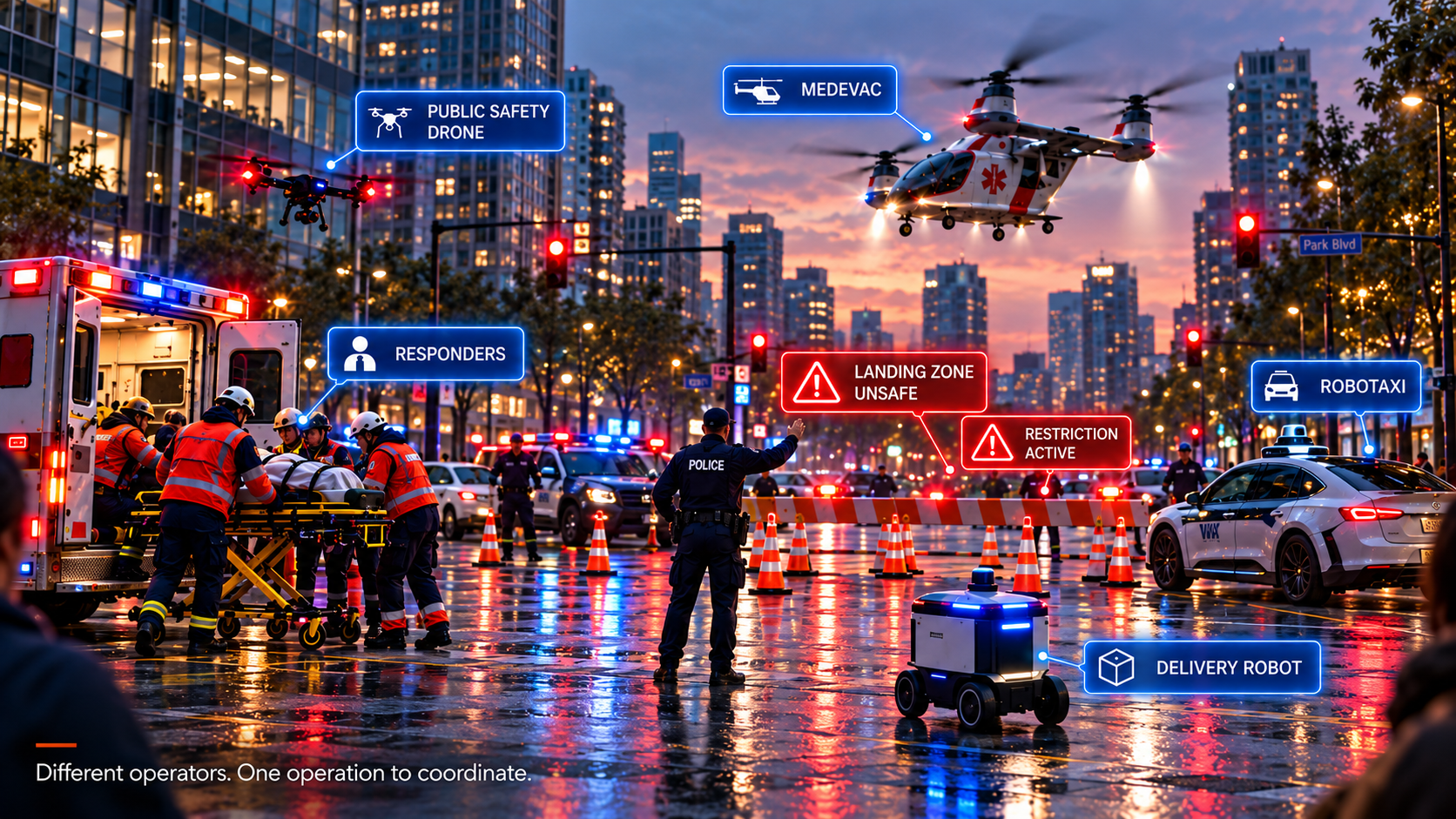
PUBLIC-SAFETY DRONEmay need to reposition
PLANNED LANDING ZONEjudged unsafe
POLICErevising restrictions
ROBOTAXI · DELIVERY ROBOTsharing streets with pedestrians
MEDEVAC AIRCRAFToperator assessing an alternative site
AMBULANCEneeds an accessible transfer route
WHY NOW

AUTONOMOUS MOBILITY IS EXPOSING
THE COORDINATION GAP.

Robots and autonomous vehicles are beginning to operate in shared urban spaces. Their intelligence, validation and safety systems are advancing, but safe operation in a city also depends on how these systems interact with infrastructure, emergency services, other operators and changing local conditions.

As deployments grow, coordination and orchestration become challenges that cannot be solved by improving an individual system or managing an isolated fleet. Multiple autonomous systems may need to respond to the same event, share information and adapt their behaviour across organisational and operational boundaries.

These dependencies are difficult to address when each operator works independently. They require a federation of systems that can support coordinated action while respecting different authorities, responsibilities and constraints.

The next scaling challenge is not only deploying more intelligent machines. It is enabling them to operate coherently with one another and with the city around them. A simple left-versus-right comparison makes the difference visible: without an operating system, each system responds independently; with one, they can coordinate their actions, share context and adapt as a whole.

Comparison of the same urban emergency: independently operated vehicles and emergency services responding with fragmented information on the left, and federated coordination using shared operational context on the right.
THE OPERATIONAL CHALLENGE

WHEN THE LANDING ZONE CHANGES,
WHOSE PLAN CHANGES?

Imagine a near-future emergency at a busy city intersection. Responders are treating a critically injured patient. An autonomous medical evacuation aircraft has been dispatched; a public-safety drone is monitoring the scene; police are restricting access while a landing area is secured. An ambulance, a robotaxi, a delivery robot and pedestrians all occupy parts of the same urban environment.

Then the planned landing zone is judged unsafe. Responders identify an alternative, but the aircraft operator must assess whether it is suitable. The drone may need to move, police may revise restrictions, the ambulance needs an accessible transfer route, and nearby autonomous systems must adapt to the new constraints.

No single participant controls the whole operation. Yet one change creates dependencies among many.

Each participant keeps its own decisions

Aircraft operator
Flight safety and the suitability of a landing site.
Police
Ground restrictions and access to the scene.
Incident and medical personnel
Patient care and their own operational responsibilities.
Autonomous fleet operators
How their vehicles and robots behave locally.

This is an illustrative stress test, not a claim that autonomous passenger-carrying medical evacuation aircraft routinely operate in cities today. A shared operating layer would not issue unconditional instructions to any of these participants.

Urban emergency response involving medical responders, police, an autonomous medical evacuation aircraft, a public-safety drone, a robotaxi and a delivery robot, with operational restrictions affecting multiple independent systems.

ONE DECISION. SEVERAL INDEPENDENT SYSTEMS. ONE OPERATION TO COORDINATE.

DEPLOYMENT COMPLEXITY

THE CITY CHANGES
ALL THREE CONDITIONS.

A city is not a bigger factory. It is an open, continuously changing operating space where emergency services, municipal authorities, aviation operators, transport operators, private autonomous systems and people share consequences without sharing one controller, data model, owner or authority.

The Factory's three working dimensions show what changes. They are exploratory lenses, not a formal classification or score.

CITY PROFILE · QUALITATIVE POSITIONS City Factory reference

ENVIRONMENTAL UNCERTAINTY

How predictable is the physical environment in which the system must operate?

ENGINEERED / BOUNDEDDYNAMIC

VARIABLE → OPEN

Open, continuously changing streets. Pedestrians, traffic and irregular events are less predictable than most bounded industrial workflows, though neither setting is uniform.

OPERATIONAL COUPLING

How strongly do the actions of one participant affect the actions and resources available to others?

ISOLATEDHIGH

EPISODIC / INCIDENT-DRIVEN

Systems that usually work independently can become interdependent during one incident: a landing site, a cordon and a transfer route suddenly depend on each other. Coupling is about dependence, not vendor count.

AUTHORITY DISPERSION

How widely is operational authority distributed across machines, systems, people and organisations?

CENTRALISEDDISTRIBUTED

HIGH / MULTI-ORGANISATION

Police, emergency services, aviation operators, transport providers and private fleets hold distinct decision rights. No citywide actor has unlimited authority over their systems.

Factory: coordination under relatively bounded ownership. City: federation across distributed responsibilities.

The positions are qualitative: a different combination of conditions, not a score.

OPERATING REQUIREMENTS

SIX REQUIREMENTS, NOW CROSSING
ORGANISATIONAL BOUNDARIES.

The same six requirements as the Factory. In the city, each has to hold between independent organisations.

  1. Preserve local autonomy.

    Aircraft, police, ambulances and autonomous fleets retain their local decisions, controls and safety duties.

  2. Establish shared operational context.

    Participants can relate the same location, restriction, event and time period across different representations, with provenance, freshness and uncertainty visible.

  3. Make authority explicit, scoped and dynamic.

    Who may propose, issue, amend or withdraw a restriction—and whom does it bind, where and for how long?

  4. Coordinate competing intentions.

    Conflicting routes, reserved spaces, landing plans and emergency access need governed reconciliation—not simply a common map.

  5. Federate across system boundaries.

    Municipal, emergency, aviation and vendor systems participate for the relevant operation without joining one permanent central command stack.

  6. Accumulate operational evidence.

    Decisions, acknowledgements, exceptions, interventions and observed outcomes are captured in context, within access, retention and assurance boundaries.

Shared data Shared meaning Shared action.

Neither arrow happens by itself. Moving from data to meaning, and from meaning to action, are separate architectural problems.

THE ARCHITECTURE

THREE CAPABILITIES FOR
A COGNITIVE CITY

A proposed OS for Shared Spaces is federated, governed operational infrastructure. It is not a central city brain, a universal digital twin, a single traffic controller or a replacement for emergency command.

It builds on what cities already operate. Dispatch, incident command, traffic management and aviation operations retain their roles, while shared infrastructure enables them to coordinate with other independently governed participants where their operations intersect.

The infrastructure can persist. The operational federation is bounded.

Reusable services can establish common spatial references, trusted identities, applicable restrictions, operational context and mechanisms for exchanging intentions, commitments and evidence. A particular incident brings together only the participants, information and decision rights needed for that operation, within an appropriate purpose, scope and duration.

Participants can join, change roles or leave as conditions evolve. Each retains its own intelligence, control, safety responsibilities and legitimate authority.

The objective is not to maintain one permanent operational state for the whole city. It is to make coordination across independent systems possible without rebuilding the underlying mechanisms for every new operation.

01 · SHARED UNDERSTANDING

Cognitive alignment

Grounds different spatial, temporal and semantic perspectives in a shared operational referent. Identity, origin, age and uncertainty travel with information, and observed, inferred and predicted claims stay distinct.

02 · BOUNDED PARTICIPATION

Operational federation

Brings independently governed participants into an operation for a specific purpose, scope and duration. Each keeps its authority, responsibilities and data access, and the right to decline an action it cannot safely perform.

03 · COORDINATED ACTION

Action coherence

Exposes and reconciles relevant intentions, restrictions and conflicts over shared resources. Acceptance and rejection are recorded and outcomes become inspectable, without taking over any participant's low-level control.

CONCEPTUAL REFERENCE ARCHITECTURE

COGNITIVE CITY
FUNCTIONAL ARCHITECTURE

CompoundWorks

FEDERATED OPERATING LAYER · OS FOR SHARED SPACES

Cognitive alignmentRelate different views
Operational federationBound participation
Action coherenceCoordinate intentions

FOUR SERVICES SUPPORT ALL THREE CAPABILITIES

Operational TwinGrounded context and operational memory
Human participationPeople as operational actors
Governance & authorityBounded permission to act
Operational evidenceDecisions and outcomes

HUMAN PARTICIPATION CUTS ACROSS ALL THREE

SCOPED CONTEXT · RESTRICTIONS · INTENT · RESPONSES · OUTCOMES
EMERGENCY & MEDICAL SERVICESPOLICE & MUNICIPAL AUTHORITIESAIRCRAFT & DRONE OPERATORSAUTONOMOUS FLEETSRESPONDERS & CITIZENS
These services support all three capabilities. The OS coordinates where operations intersect. Local cognition, safety and responsibility remain with each participant.

The Operational Twin is a federated, dynamically maintained referent for the shared situation, not one authoritative model of the whole city or the entire OS. Governance establishes who holds which decision rights; it does not resolve every conflict between actions.

ENABLING INFRASTRUCTURE

DIFFERENT TECHNOLOGIES.
ONE OPERATIONAL PURPOSE.

The three capabilities do not imply one technology stack. They build on complementary technologies and services, each addressing a different part of the coordination problem.

Digital twins and spatial infrastructure help relate physical places, assets, conditions and constraints across different representations. They provide spatial and contextual references, not necessarily a single authoritative model of the city.

Simulation helps participants explore alternative plans, dependencies and potential consequences before committing to action. Its fidelity and scope depend on the decision being supported and the uncertainty that needs to be reduced.

The Operational Twin connects relevant observations, constraints, intentions, decisions and outcomes into grounded, dynamically maintained operational context. It provides a shared referent for the operation at hand, without replacing the local world models or decision systems of its participants.

Human-facing interfaces, including operational consoles, mobile applications, XR and spatial interfaces, make that context understandable and actionable for people. They support inspection, decisions, intervention and accountability according to each participant's role and authority.

None of these technologies, on its own, creates operational coherence. The architectural challenge is making their contributions work together across independently governed systems, with sufficient trust, interoperability and evidence for the decisions being made.

Two related architectural perspectives explore these foundations in more detail:

ARCHITECTURAL PERSPECTIVE

Spatial Infrastructure

Examines how XR, simulation, digital twins and spatial computing can evolve from individual applications into reusable infrastructure for interacting with and operating in the physical world.

Explore Spatial Infrastructure →
ARCHITECTURAL PERSPECTIVE

The Operational Twin

Explores how physical reality becomes grounded, computable operational context that independently governed systems and people can use to coordinate decisions and actions.

Explore the Operational Twin →
FROM SHARED PICTURE TO VERIFIED CHANGE

A PLAN CHANGE IS NOT
AN ACTION COMPLETED.

  1. Change proposed

  2. Authority and validity established

  3. Relevant parties notified

  4. Accepted, declined or timed out

  5. Local action

  6. Outcome observed or exception escalated

Sharing a new landing-zone location is not enough. Participants must know the source of the decision, who is authorised to make it, what it applies to, when it becomes valid and when it expires. They must be able to distinguish a message received from a constraint accepted, and an intended action from one actually performed.

Some participants may reject a proposed change, lack current information or lose connectivity. The operation needs visible exceptions and domain-appropriate fallback and escalation paths—not an assumption that distribution equals compliance. Verification mechanisms vary with the domain and the risk.

RELIABILITY IS RELATIVE TO THE DECISION

Information adequate for situational awareness may not justify closing an exit, redirecting an ambulance or authorising an autonomous manoeuvre. Sources, freshness, uncertainty and applicability have to remain inspectable by the people responsible for acting.

  • Issued
  • Acknowledged
  • Accepted
  • Executed
  • Independently observed
HUMAN PARTICIPATION

PEOPLE PARTICIPATE
IN THE SAME OPERATION.

Responders, incident commanders, public employees and citizens are operational actors with judgement, roles and the right to intervene. Their obligations differ, so responders receive different controls and information from members of the public.

Interfaces can be operational consoles, mobile devices, familiar dispatch channels and, where useful, spatial AR views. Approved evacuation or emergency-access routes might appear in responders' smart glasses; a voice-based AI agent could guide a person along a currently authorised route.

Incident commanders and responders need to see:

  • What changed, and on whose authority.
  • Which constraints apply, where and until when.
  • What information may be stale or contested.
  • Which systems have accepted the revised plan.
  • Where they can intervene when a participant cannot comply.

Prediction services could anticipate crowd movement and compare courses of action, but a predicted route must never be presented as confirmed safe or authorised merely because an algorithm selected it. XR and voice are options. Accessible, resilient communication comes first.

SHARED OPERATIONAL MEMORY

SHOULD EVERY NEW SYSTEM
HAVE TO RELEARN THE CITY?

Every new autonomous fleet entering a city must understand more than its streets. It encounters local restrictions, emergency procedures, infrastructure dependencies, operational interfaces and authorities that may differ from those in another city.

Today, much of that knowledge and integration work is developed separately by each operator.

As more autonomous vehicles, drones, robots and intelligent infrastructure enter shared urban spaces, repeating these integrations could become a significant constraint on deployment and scale.

The opportunity is to make the reusable parts of operational coordination into shared infrastructure.

Each incident reveals something about how a place actually operates: temporary constraints, human interventions, disputed information, coordination failures, exceptions and what ultimately worked.

A governed operational memory could preserve relevant evidence and context, making it available for future planning, integration, simulation and qualification activities.

But memory alone is not enough.

Reusable infrastructure could also provide common mechanisms for discovering relevant participants, establishing authority, exchanging operational restrictions, coordinating intentions, acknowledging commitments and reporting outcomes.

A new autonomous service would still need to meet local requirements and demonstrate its own safety and operational readiness. But it would not necessarily have to reconstruct every interface and coordination mechanism from the beginning.

FROM DEPLOYMENT OVERHEAD TO INFRASTRUCTURE VALUE

The economics of Physical AI are emerging across three connected layers:

LAYER 01

Developing intelligence.

Building the models, capabilities and learning systems that allow machines to understand and act in the physical world.

LAYER 02

Deploying intelligence.

Validating, integrating and assuring those capabilities for particular machines, environments and operating conditions.

LAYER 03

Operating intelligence together.

Enabling independently governed systems and people to share operational context, coordinate actions and manage their dependencies in the same physical space.

The Cognitive City explores this third layer.

As more participants use shared coordination mechanisms, the cost of integrating additional services could decrease, while the accumulated operational knowledge and evidence become more valuable.

That creates a potential infrastructure market extending beyond individual autonomous vehicle fleets or city-specific integration projects.

WHERE REUSE STOPS

Not every operational constraint can be standardised, and not every piece of evidence can be transferred.

Cities differ in infrastructure, regulations, authorities and operating conditions. A restriction valid for one incident may not apply to another. One vendor's operational performance does not automatically qualify another vendor, vehicle, configuration or use case.

Shared services therefore need explicit governance, access controls, provenance, retention rules and domain-appropriate assurance. Reuse must remain bounded by the context in which information and evidence are valid.

WHO BUILDS, MAINTAINS AND GOVERNS THE SHARED INFRASTRUCTURE?

And how can cities, operators and technology providers capture its value without creating another central platform dependency?

NOT ONE CITY BRAIN. A WAY TO COORDINATE MANY.

The Cognitive City is not a city that thinks with one mind. It is an operating space where independently governed people and systems can share relevant context, respect bounded authority, coordinate intentions and make outcomes visible—especially when the plan changes.

Intelligence belongs to the participants. The shared operating infrastructure makes their cooperation possible where the operation crosses their boundaries.
