PHYSICAL AI · OPERATIONAL SPACES · FACTORY

WHEN THE FACTORY DISAGREES WITH ITSELF

A factory can contain intelligent robots, digital twins, AI agents, safety systems and highly skilled people — and still fail as a system when each participant acts on a different view of reality.

Physical AI needs more than smarter machines.

It needs shared operational infrastructure.

MES / PRODUCTIONpriority change
SAFETYtemporary restriction
ROBOT Aclear route / high production priority
ROBOT Breserved workspace
SHARED WORKSPACEthe contested physical area
TECHNICIANentering shared workspace

A factory is increasingly becoming a system of independently intelligent participants sharing the same physical environment.

Robot perception can improve.
World models can improve.
Planning can improve.
Reasoning can improve.

And the factory can still fail as a system.

The problem appears when multiple autonomous systems, people and operational systems must understand the same situation, coordinate their intentions, respect changing authority and learn from what actually happened.

The bottleneck starts moving outside the individual machine.

This is where an operating layer for shared autonomous spaces becomes necessary.

ONE FACTORY. MULTIPLE VERSIONS OF REALITY.

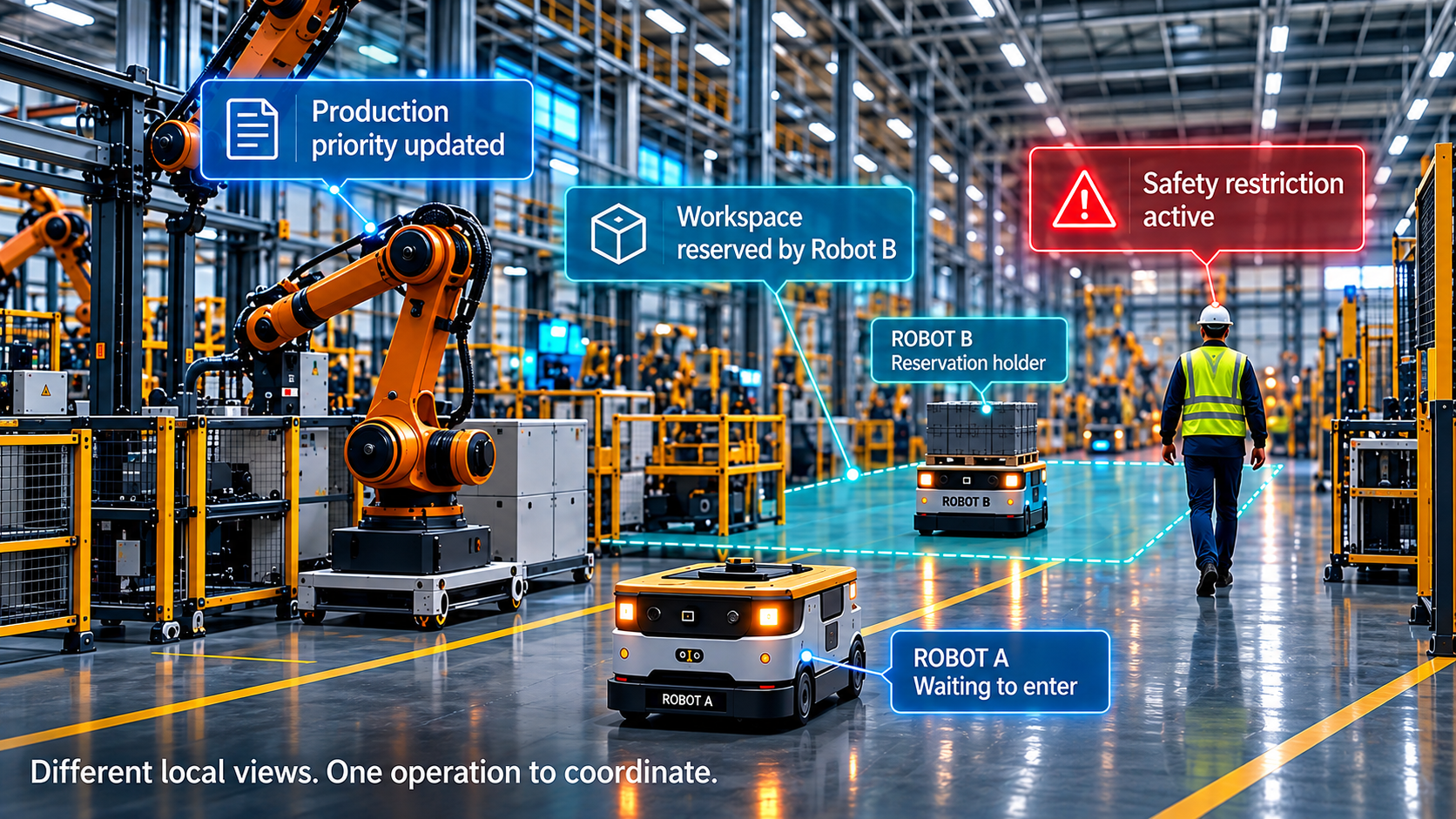
Imagine a factory where Robot A intends to enter a shared workspace while Robot B has already reserved part of it.

The production system has just increased the priority of Robot A's task.

At the same time, a technician enters the area.

A safety system has issued a temporary restriction affecting part of the workspace.

Robot A's local perception still sees a navigable path.

Robot B knows about its reservation.

The production system knows that Robot A now has higher priority.

The safety system knows about the restriction.

A wearable or spatial sensor knows that the technician has entered the area.

And the technician needs to understand what the machines around them are going to do.

None of those systems necessarily has to be wrong.

But when they operate independently, without sharing a sufficiently aligned Operational Reality:

Factory coordination scenario showing Robot A intending to enter a shared workspace reserved by Robot B while production priority changes, a technician enters the area and a safety restriction is active.

LOCAL INTELLIGENCE CAN BECOME GLOBAL CONFUSION.

WHY THE FACTORY IS ALREADY A SYSTEMS PROBLEM

ENVIRONMENTAL UNCERTAINTY

How predictable is the physical environment in which the system must operate?

ENGINEERED / BOUNDEDDYNAMIC

BOUNDED → DYNAMIC

Factories are engineered environments, but people, mobile robots, temporary restrictions, maintenance activity, production changes and failures continuously introduce uncertainty.

OPERATIONAL COUPLING

How strongly do the actions of one participant affect the actions and resources available to others?

ISOLATEDHIGH

HIGH

Robots, workers, production systems and infrastructure increasingly share corridors, workspaces, machines, chargers, lifts, loading areas and production priorities.

AUTHORITY DISPERSION

How widely is operational authority distributed across machines, systems, people and organisations?

CENTRALISEDDISTRIBUTED

MODERATE — AND INCREASING

A factory may still have a clear organisational owner, but operational authority is already distributed across production, maintenance, safety, robot fleets, software platforms and multiple vendors.

The factory is therefore not merely an automation problem.

It is increasingly a shared-operation problem.

AN OPERATING LAYER FOR THE SHARED FACTORY

To coordinate this temporary Operational Reality without replacing local autonomy, the operating layer needs six properties.

01 · PRESERVE LOCAL AUTONOMY

LOCAL AUTONOMY REMAINS LOCAL.

SHARED OPERATING LAYERSHARED CONTEXT / CONSTRAINTS / INTENTSUPERVISORY COORDINATION
ROBOT ALOCAL
CONTROL
ROBOT BLOCAL
CONTROL
SAFETYLOCAL
CONTROL

Each robot should still be responsible for its own motion and behaviour.

The safety PLC should remain responsible for the deterministic safety functions it owns.

The operating layer should act as a supervisory and coordination layer, not as a central brain.

Its role is to give participants enough shared operational context to make coherent local decisions.

Otherwise, we create latency, fragility and a new single point of failure.

And when connectivity degrades, the factory must not suddenly forget how to operate safely.

LOCAL AUTONOMY REMAINS LOCAL.
COORDINATION HAPPENS THROUGH SHARED CONTEXT, CONSTRAINTS AND INTENT.

Operational value
Resilience, bounded responsibility and local control.
Failure mode
Centralisation, latency, fragility and unsafe dependence on connectivity.

02 · ESTABLISH SHARED OPERATIONAL CONTEXT

SHARED DATA IS NOT SHARED REALITY.

Each participant sees the situation differently.

Robot A sees a clear route.

Robot B sees a committed reservation.

The production system sees a priority change.

The safety system sees a restricted zone.

The human-tracking system sees the technician entering it.

Sharing raw data is not enough.

The participants need a sufficiently aligned understanding of what is happening now.

This is the role of the Operational Twin:

not another world model replacing the local models of robots, but a living shared operational referent reconciling the relevant state of the physical environment.

Shared operational context must carry more than position and geometry.

PHYSICAL REALITY
SHARED OPERATIONAL REFERENTOPERATIONAL
TWIN
ROBOT A
ROBOT B
MES
SAFETY
TECHNICIAN / HUMAN
AI AGENTS
  • PROVENANCE
  • FRESHNESS
  • CONFIDENCE
  • OWNERSHIP
  • VALIDITY
  1. REALITY
  2. ↔OPERATIONAL TWIN
  3. ↔HUMANS, ROBOTS AND AI AGENTS

OTHERWISE THE FACTORY MAY COORDINATE PERFECTLY AROUND YESTERDAY'S REALITY.

EXPLORE THE OPERATIONAL TWIN

03 · MAKE AUTHORITY EXPLICIT, SCOPED AND DYNAMIC

PRIORITY IS NOT PERMISSION.

The production system can increase the priority of Robot A.

That does not mean Robot A is allowed to enter a space temporarily restricted because a technician is there.

The shared operating layer needs to represent more than what participants can do.

It must also represent what they are permitted to do now.

Authority needs operational context.

Authority is contextual, not a permanent property of the robot.

The same machine may be authorised to cross a workspace during normal operation, lose that authority while maintenance is taking place, and regain it once the condition has been cleared.

CAPABILITY
ROBOT AWORKSPACE

CAPABILITY ANSWERS:
CAN IT DO IT?

AUTHORITY
ROBOT AWORKSPACE

AUTHORITY ANSWERS:
IS IT ALLOWED TO DO IT NOW?

PRIORITY ≠ PERMISSION

Failure mode
A highly capable machine can still make the wrong operational decision because it understands what is possible but not what is permitted.

04 · COORDINATE COMPETING INTENTIONS

SHARED STATE DOES NOT GUARANTEE COORDINATED ACTION.

SHARED STATE ≠ COORDINATED ACTION
ROBOT A
ROBOT B
SHARED WORKSPACE
COORDINATE INTENTIONS
ROBOT ASHARED WORKSPACEROBOT B
  • RESERVATIONS
  • TRAJECTORIES
  • RESOURCE CLAIMS
  • PRIORITIES
  • COMMITMENTS
  • HANDOVERS
  • CORRIDORS
  • LIFTS
  • CHARGERS
  • LOADING BAYS
  • MACHINES
  • INSPECTION STATIONS

Suppose the technician leaves and the safety restriction is removed.

Robot A and Robot B may now know exactly the same thing about the workspace.

They can still both decide to enter it.

Shared state and action coordination are different problems.

The operating layer therefore needs a way to expose intentions and commitments early enough to resolve conflict.

PERFECTLY RATIONAL LOCAL DECISIONS CAN STILL BE GLOBALLY INCOMPATIBLE.

Operational value
Action coherence across independently intelligent systems.
Failure mode
Conflicts emerge even when every participant has correct information.

05 · FEDERATE ACROSS BOUNDARIES

THE FACTORY CANNOT REQUIRE ONE VENDOR TO OWN EVERYTHING.

Now make the factory realistic.

Robot A comes from one vendor.

Robot B comes from another.

The safety infrastructure comes from somebody else.

The technician's wearable belongs to another system.

Production priorities come from MES.

Maintenance uses its own software.

Some systems exchange data through an industrial data platform.

Others use their own fleet managers, edge infrastructure or proprietary platforms.

The answer cannot be that one vendor owns the complete stack.

Participants need to federate around the operational scenario while keeping their local autonomy.

And that federation does not have to exist permanently.

Robot A, Robot B, the technician and the affected infrastructure may participate in the same Operational Reality only while their actions are mutually dependent.

Once that scenario ends, they return to their local context.
ROBOT A VENDOR
ROBOT B VENDOR
MES
SAFETY
MAINTENANCE
HUMAN SYSTEM
TEMPORARY FEDERATIONOPERATIONAL REALITY
  • PARTICIPATING ACTORS
  • ROLES AND AUTHORITY
  • APPLICABLE CONSTRAINTS
  • OPERATIONAL SCOPE
  • VALIDITY WINDOW
LOCAL AUTONOMY PERSISTS.

FEDERATION IS TEMPORARY.
LOCAL AUTONOMY PERSISTS.

EVERY NEW PARTICIPANT SHOULD NOT BECOME ANOTHER CUSTOM INTEGRATION PROJECT.

THAT IS NOT SCALING.
IT IS INTEGRATION DEBT.

Operational value
Cross-vendor participation without surrendering local autonomy.
Failure mode
Every deployment becomes another bespoke systems-integration project.

06 · ACCUMULATE OPERATIONAL EVIDENCE

A LOG IS NOT OPERATIONAL EXPERIENCE.

Imagine the situation is resolved.

The technician entered the area.

The safety restriction was activated.

Robot A stopped or rerouted.

Robot B released or changed its reservation.

A supervisor may have intervened.

Production eventually resumed.

If all the factory retains is:

“Robot A stopped at 10:42”

it has learned very little.

Operational evidence must preserve the context.

The next version of Robot A — or the next factory deploying the same system — should not need to rediscover the same exception from scratch.

OPERATIONAL EVENTRobot A stopped at 10:42ROBOT A · ROBOT B · TECHNICIAN · SAFETY
CONTEXT CAPTURED
  • WHY DID IT STOP?
  • WHAT DID EACH PARTICIPANT BELIEVE?
  • WHICH CONSTRAINT APPLIED?
  • WHO HAD AUTHORITY?
  • WAS THE RESTRICTION PROPAGATED?
  • DID A HUMAN INTERVENE?
  • WHAT HAPPENED AFTERWARDS?
EVIDENCEbeliefs · constraint · authority · human intervention · outcome
  1. SIMULATION
  2. →TESTING
  3. →VALIDATION
  4. →QUALIFICATION
  5. →UPDATED OPERATION
SMART FACTORYsenses + optimises
COGNITIVE FACTORYretains contextual operational experience

A SMART FACTORY SENSES AND OPTIMISES.

A COGNITIVE FACTORY ALSO ACCUMULATES OPERATIONAL EXPERIENCE.

“Cognitive factory” is CompoundWorks terminology, not an external industry maturity category.

HUMANS SHARE THE SAME OPERATIONAL REALITY.

Humans cannot be treated as an exception outside the architecture.

They participate in the same Operational Reality as robots, machines and AI agents, but through different cognition, interfaces, responsibilities and authority.

The human participation layer must connect operational context with the person who needs to understand it and act on it.

  1. OPERATIONAL REALITY
  2. ↕HUMAN MODEL
  3. ↕COGNITIVE INTERACTION
  4. ↕SPATIAL INTERFACE
  5. ↕HUMAN ACTION

The system may need to understand relevant human context such as:

  • LOCATION
  • ROLE
  • ACTIVITY
  • READINESS / OPERATIONAL CONTEXT

The human needs access to:

  • SYSTEM STATE
  • MACHINE INTENT
  • CONSTRAINTS
  • UNCERTAINTY
  • AUTHORITY
  • REQUIRED INTERVENTION

A technician does not need the same operational window as a supervisor.

A supervisor does not need the same operational window as maintenance.

Safety personnel may need yet another view.

But they should all operate against the same sufficiently aligned Operational Reality.

ONE OPERATIONAL REALITY.
DIFFERENT WINDOWS.

ONE SHARED REFERENTOPERATIONAL REALITYSPATIAL INTERFACE / XR

TECHNICIAN

Local hazard, affected equipment, nearby machine intent.

SUPERVISOR

Production impact, exceptions, priorities and authority.

MAINTENANCE

Asset condition and intervention scope.

SAFETY

Restricted areas, active constraints, authority and validity.

XR and spatial computing can therefore become more than visualisation.

They can become the human-facing spatial interface into shared Operational Reality.

THE VALUE IS IN THE COMBINATION.

No single technology solves the shared-operation problem.

The value emerges when multiple capabilities are composed into one operational architecture.

  • ROBOTICS / PHYSICAL AI
  • AI / WORLD MODELS
  • DIGITAL TWINS / REAL-TIME 3D
  • SPATIAL COMPUTING / XR
  • SIMULATION
  • HUMAN + ENVIRONMENTAL SENSING
  • INDUSTRIAL DATA + INTEROPERABILITY
  • OPERATIONAL GOVERNANCE
  • QUALIFICATION + EVIDENCE
OPERATIONAL COMPOSITIONSHARED
OPERATIONAL
ARCHITECTURE

THESE TECHNOLOGIES BECOME MORE VALUABLE TOGETHER THAN SEPARATELY BECAUSE THE OPERATIONAL PROBLEM REQUIRES THEM TO COMPOUND.

THE COMPOUNDWORKS VISION

SIMULATION PREPARES. OPERATIONS SEASON.

  1. OPERATE
  2. →OBSERVE
  3. →CAPTURE EXPERIENCE
  4. →SIMULATE
  5. →VALIDATE
  6. →QUALIFY
  7. →UPDATE
  8. →OPERATE
HUMAN INTERVENTION

Human intervention is part of the same evidence loop.

If a technician changes a route, a supervisor overrides a decision or an operator resolves an ambiguity, that intervention must not disappear into a black box called “human in the loop”.

It is operational evidence.

The goal is not simply to make the current deployment work.

Each deployment should make the next deployment easier to understand, validate and qualify.

THE BOTTLENECK HAS MOVED OUTSIDE THE ROBOT.

The vendors of Robot A and Robot B could improve their perception, world models, reasoning and planning enormously and still not solve the shared-operation problem.

Because the bottleneck increasingly sits outside the individual machine.

Physical AI needs more than robot intelligence.

It needs operating infrastructure able to:

SHARED OPERATING LAYEROPERATIONAL
REALITY
  • PRESERVE LOCAL AUTONOMY
  • ESTABLISH SHARED OPERATIONAL CONTEXT
  • MAKE AUTHORITY EXPLICIT
  • COORDINATE INTENTIONS
  • FEDERATE PARTICIPANTS
  • ACCUMULATE OPERATIONAL EVIDENCE
  • ENABLE HUMAN PARTICIPATION

A SHARED OPERATIONAL ARCHITECTURE IN WHICH HUMANS, ROBOTS AND AI AGENTS PARTICIPATE THROUGH DIFFERENT INTERFACES, DIFFERENT COGNITION AND DIFFERENT AUTHORITY — BUT OPERATE AGAINST A SUFFICIENTLY ALIGNED OPERATIONAL REALITY.

FACTORY IS ONLY THE FIRST STRESS TEST.

FACTORY

CURRENT

COORDINATION UNDER COMPLEXITY

Bounded but increasingly dynamic environments.
High operational coupling.
Authority still relatively concentrated, but increasingly distributed across systems and vendors.

CITY

NEXT

FEDERATION UNDER DISTRIBUTED OWNERSHIP

Open environments.
Very high operational coupling.
Multiple organisations, infrastructures, jurisdictions and untrained public participants.

BATTLEFIELD

NEXT

TRUSTED OPERATION UNDER CONTESTED REALITY

Degraded and adversarial environments.
Extreme operational coupling.
Distributed and dynamically changing authority under incomplete or contested information.

ENVIRONMENTAL UNCERTAINTY
OPERATIONAL COUPLING
AUTHORITY DISPERSION

THE FACTORY MAY BE ONE OF THE FIRST PLACES WHERE THIS OPERATING ARCHITECTURE CAN BE BUILT AND TESTED.

THE CITY AND THE BATTLEFIELD MAKE THE PROBLEM MUCH HARDER.

FROM AUTONOMOUS MACHINES TO OPERATIONAL CAPABILITY

Scaling Physical AI is not only a model problem.

It is an architecture, integration, evidence and operational trust problem.